AI for Renewal Management: How Outlit Works a Renewal
Author: Josh Earle

Most renewal risk isn't a surprise. Someone on the team already knew the champion left, or that the migration stalled in March, or that finance asked for a list of vendors. The knowledge just sits in a call recording, a Slack thread, and a support ticket, and nobody puts it together until the renewal is 30 days out. AI for renewal management earns its keep when it does that assembly continuously, works out what the team is already doing about the account, and moves the plan forward. That's what Outlit's AI customer success agent is built to do.
Two accounts can look identical in the CRM and need opposite plays. One is growing usage while finance quietly cuts vendors. The other has gone quiet because a migration is blocked, not because anyone stopped caring. Outlit's job is to tell those apart and act on the difference.
What AI for renewal management has to read first
Outlit assembles the account from the systems the work already lives in, through its Customer Context Graph:
- Renewal dates, stakeholders, and deal notes from HubSpot, plus subscription and payment changes from Stripe.
- Product usage from PostHog or the Outlit SDK, and open tickets and escalations from Pylon.
- Customer email in Gmail, calls in Granola, Fireflies, or Gong, and the internal back-channel in Slack.
It also watches for news about the customer's company. A new VP puts the champion's project under review. Layoffs are the first place to look when a seat reduction shows up with no explanation. Funding or an acquisition reshuffles priorities. Outlit attaches that news to the account with its source and date. It's a prompt to go look, not a verdict.
Every assessment keeps its evidence attached and says what's still missing. That customer context infrastructure is what lets the agent explain why it recommends a particular step for this account instead of a generic one.
The renewal brief
The brief answers four questions: what changed, why it matters, what the evidence is, and what to do next. It also shows the approach already underway, how far along it is, and the open questions that could change the recommendation.
Picking up the approach already in motion
An approach is the plan for getting an account to a signed renewal. Clear the blocker. Build the value case for finance. Rebuild the relationship after the champion left. Most accounts already have one, even if it only exists in a CSM's head and last week's call notes. Outlit reads that plan out of conversations and account activity, including work the team started outside Outlit, and carries it forward instead of proposing a fresh one.
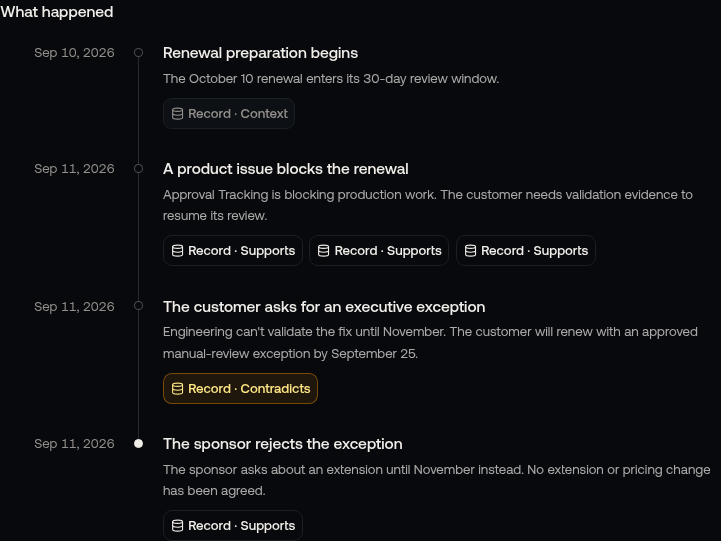
In the timeline above, the customer first asks for an executive exception because the product fix won't be validated before renewal. When the sponsor rejects that exception, the approach needs to change. The next step is to confirm the extension the customer wants and whether the team can approve it. An extension hasn't been agreed, and the renewal is still unresolved. Outlit carries the earlier work forward while updating what needs to happen next.
Outlit reassesses when new evidence lands, not only at the 90, 60, and 30-day checkpoints. Those checkpoints are still a sensible way to schedule human review. They're just no longer the only time the plan changes.
When expansion belongs in the renewal plan
Some accounts arrive at renewal with a bigger contract already forming. Say an account has been near its seat limit for two months. Usage that started in support has spread to operations and enablement. On the last call the champion asked whether the same workflow could cover a new region. Outlit reads those signals into the approach the same way it reads a blocker, and widens the plan from getting to the signature to working out what a larger agreement should cover.
The next step is discovery: who the new users would be, who'd sign for them, and whether the timing lands with the renewal or after it. If the answers hold up, the account owner takes one case to the customer covering the renewal and the added scope, built on the adoption that already happened. If a problem threatens the renewal itself, the plan fixes that first. And because the expansion sits in the approach Outlit is already tracking, a budget freeze or a champion leaving becomes a reason to defer it rather than a surprise at the negotiating table.
Taking action on long-tail and strategic accounts
We're building Outlit to carry the work through to the customer. That means sending the right resource, asking whether a fix worked, and chasing an unanswered question. Here's how it behaves:
For long-tail accounts, the goal is to get routine work done without a person in the loop for each step. Usage stalls on a mid-tier account, and Outlit sends the guide that matches how that customer uses the product, then watches whether usage or the conversation changes. Support closes a ticket, and Outlit asks the customer whether the problem is actually gone. When the customer asks something Outlit can't answer, when risk persists after the play, or when the request is outside its remit, it hands the thread to a person with the context attached.
For strategic accounts, the account owner stays in front of the customer and Outlit does the preparation. It keeps the brief current, flags stakeholder changes, drafts the outreach and pulls the resources, and tracks what each side promised. The CSM shows up to the call having read the investigation instead of having done it.
How much runs on its own should depend on the account and the action. Sending a help article is a different decision from offering a discount. Pricing, contract terms, and anything already escalated stay with an owner. A team can start by reviewing every message and loosen that once it's seen what the agent sends.
Remembering what saved the account
When an at-risk account reaches its renewal date, Outlit records what happened next to the risk it saw, the plays it ran, and how the customer responded. Renewed, expanded, downgraded, or churned.
That matters because a completed play isn't a saved account. The guide was sent. The ticket was closed. Whether the customer stayed is a separate fact, and teams that only track the first one end up repeating plays that never worked. Outlit keeps both, so when a similar account shows up it can point to what was tried before and how it ended. A renewal after a play is evidence, not proof that the play caused it, and the record says so.
Book a walkthrough to run Outlit against your own renewal book, or read when a CRM is enough and when a customer success platform like Outlit earns its seat.
FAQ
What's AI for renewal management?
AI for renewal management is software that investigates renewal risk on its own, keeps the account plan current, and helps carry it out. In Outlit's case it's an agent that reads usage, billing, support, and conversations, works out the approach already underway, and updates it as new evidence arrives.
Can Outlit pick up a renewal plan the team started outside Outlit?
Yes. It reads the approach from existing conversations and account activity, then tracks progress and new blockers from there. Nobody has to re-enter the plan.
Can Outlit send resources and follow up on its own?
That's the outreach workflow we're building. Teams will be able to let the agent handle routine steps, such as sending a relevant guide or asking whether a fix worked, and keep pricing, contract, and escalation decisions with a person.
How does Outlit know whether a retention play worked?
It records the renewal outcome for each at-risk account alongside the plays used and the customer's response. Sending a guide is an action. The renewal is the outcome. Outlit keeps both and doesn't treat one as proof of the other.